We talk a lot about climate change but in reality even what little we are doing to mitigate the problem could well be making it worse. We should be more honest in our intent.
The clearest exposition I have found on the argument that climate change is occurring and that there is a human component is presented by the Royal Society here.
Imagine you wanted to put as much carbon dioxide in the atmosphere as possible. How would you do it? Scavenge as much oil, coal and natural gas out of the ground as you could? Strive to keep the price low? Encourage industrial growth and consumption worldwide? All of the above?
Now imagine you want to do the opposite. Extend the use of nuclear power, encourage renewable energy sources, attempt to reduce demand and trade in carbon credits?
If you really meant it, then you'd also add in the opposite actions of your first list. Sadly, when it comes to our collective actions, we don't really mean it.
Our economy doesn't really care about climate change or emissions reductions. We tinker here and there. Nuclear power, renewables or demand reduction could reduce greenhouse gas emissions, but these are secondary effects to the real reason we pursue these options. What we really care about is energy price and security of supply.
What about carbon credits? Are they, at least, part of climate change mitigation? No. The tax insufficient to stop demand, and I doubt if we would ever stomach the price levels that would affect demand. Recent gas price increases have already called for a reduction in emissions controls. Worse yet, much of the tax take is simply sitting in the coffers of government, whose objective is economic growth. Economic growth increases greenhouse gas emissions. Perversely, the carbon tax could therefore be spent putting more carbon dioxide in the atmosphere.
We can either create economic growth or address climate change. We are not ready to harm the former for the sake of the latter. In turning to technology, we might be able to do the former and the latter together. But we should stop pretending to ourselves that we really yet care, let alone have a plan.
Sunday, January 22, 2006
Wednesday, October 19, 2005
UK vs high-growth energy economies and CO2
China's current rate of energy sector growth is equivalent to the whole of the UK's energy sector per year. What is the point, therefore, of a UK effort to reduce CO2 emissions if the focus is not on exporting technology and knowledge to China (and India)? The UK could switch off its entire CO2 production immediately, a goal far beyond the aspirations of the most ardent environmentalist, and merely shift the CO2 timeline by 12 months.
Instead, if they want to make a difference, the UK and others must concentrate on global technology and market solutions that the high-growth world will adopt.
Instead, if they want to make a difference, the UK and others must concentrate on global technology and market solutions that the high-growth world will adopt.
Sunday, October 02, 2005
Go-oogle
I wish there was one place to go to plan a route. You could call it go-oogle.
You'd say "I want to go from 23 Acacia Avenue to Rijswijk" and it would give you a route optimised for time, cost, CO2 or Ozone profile, as you wished, covering taxis, trains, flights, boats, subways and so on. Maybe it could search interesting events and suggest a lay-over at a hotel for a concert the night before.
I'd like it to know things like it takes 2 hours to check into an international flight and 45 minutes between a domestic landing at London Stansted to get to the train platform for London. I could tell it that but the database would build up even more quickly if people shared this kind of knowledge.
Another way of looking at it is an expanded Expedia or Transport for London (which does a reasonable job of integrating buses, trains and the Underground metro).
It would get the bulk of it's data from online sources, much like the way I imagine Froogle works. A table and a bit of dynamic programming would work wonders.
You could improve your company's costs by understanding the implications of flying to the outskirts of a city and taking a cab, as opposed to taking a train to the centre.
Revenue from online advertising of travel services in the normal Google style, as well as local services at either end or along the route. It could sell tickets or link to ticket vendors. It could suggest lay-overs to take in concerts.
I wish the future would happen sooner.
You'd say "I want to go from 23 Acacia Avenue to Rijswijk" and it would give you a route optimised for time, cost, CO2 or Ozone profile, as you wished, covering taxis, trains, flights, boats, subways and so on. Maybe it could search interesting events and suggest a lay-over at a hotel for a concert the night before.
I'd like it to know things like it takes 2 hours to check into an international flight and 45 minutes between a domestic landing at London Stansted to get to the train platform for London. I could tell it that but the database would build up even more quickly if people shared this kind of knowledge.
Another way of looking at it is an expanded Expedia or Transport for London (which does a reasonable job of integrating buses, trains and the Underground metro).
It would get the bulk of it's data from online sources, much like the way I imagine Froogle works. A table and a bit of dynamic programming would work wonders.
You could improve your company's costs by understanding the implications of flying to the outskirts of a city and taking a cab, as opposed to taking a train to the centre.
Revenue from online advertising of travel services in the normal Google style, as well as local services at either end or along the route. It could sell tickets or link to ticket vendors. It could suggest lay-overs to take in concerts.
I wish the future would happen sooner.
Wednesday, September 14, 2005
Energy knowledge
Energy is crucial to almost every aspect of our economy. Our current use of energy is predicated on the idea of an abundance of cheap sources. Now, the prices are rising. We should prepare to behave differently and knowledge is going to help.
We have not yet reached peak oil production, the significant point at which supply will no longer be able to grow to reach an increasing demand. Nevertheless, fossil fuel prices at present are high, due in part to low investment in the last ten years. Demand is rising, especially in China, which has only just begun to motorize in significant volume. Chinese motorization is significant not just because of the size of the growth, but also because of the lack of an alternative fuel for cars.
Economists assure us that GDP in the US and Europe is less dependent on oil than it once was and that therefore we are better prepared than we once were for increased energy costs. Sadly, the laws of physics haven't changed. Our imports, once manufactured domestically, still require energy. We will pay additional import costs one way or another.
This is no bad thing. Higher fossil fuel costs will do more to mitigate climate change than any amount of imploring from well-intentioned commentators. Innovation in energy might provide greater political stability, too.
Information will be critical to energy innovation, to support decisions to reduce demand, improve efficiency, make new investments in breakthrough technologies and undertake fundamental research and science.
There is a socially important and profitable future in energy and knowledge.
We have not yet reached peak oil production, the significant point at which supply will no longer be able to grow to reach an increasing demand. Nevertheless, fossil fuel prices at present are high, due in part to low investment in the last ten years. Demand is rising, especially in China, which has only just begun to motorize in significant volume. Chinese motorization is significant not just because of the size of the growth, but also because of the lack of an alternative fuel for cars.
Economists assure us that GDP in the US and Europe is less dependent on oil than it once was and that therefore we are better prepared than we once were for increased energy costs. Sadly, the laws of physics haven't changed. Our imports, once manufactured domestically, still require energy. We will pay additional import costs one way or another.
This is no bad thing. Higher fossil fuel costs will do more to mitigate climate change than any amount of imploring from well-intentioned commentators. Innovation in energy might provide greater political stability, too.
Information will be critical to energy innovation, to support decisions to reduce demand, improve efficiency, make new investments in breakthrough technologies and undertake fundamental research and science.
There is a socially important and profitable future in energy and knowledge.
Do better by being informed
'Knowledge Management' is a hateful phrase, despised for failing to deliver or failing to define itself. This is a shame, because the original idea - do better by being informed - is a good one. What happened?
Do better - waste less, spend less, sell more, charge more, make a greater margin - by making good decisions. Your decisions are more likely to deliver results if you are well informed. Knowledge management was meant to support such decisions by delivering answers to the right people at the right time and place. It was to do this by recording, measuring, instrumenting, institutionalising journalism, creating searchable archives of electronic data and promoting knowledge sharing between people.
The technical difficulty is the first hurdle. Assuming you can capture all this information, to make a difference you need to use it to build a landscape and plot a profitable course through that landscape. The scientific method of recording data, hypothesizing and inferring correct causal relationships is not easy. But then, try doing it without the data in the first place.
The second hurdle is that at a management level the big picture is easily missed and it loses priority. People latch on to a component - a search engine, a web page, the idea of having meetings - and equate knowledge management to just that. It's then easy to reduce its priority. Other things take over, such as the urgent need to make a decision, and the knowledge management effort is lost while everyone scrabbles around for the information needed to make that decision.
If the phrase 'knowledge management' isn't working in your environment, drop it. But don't lose sight of the value of being informed when you need to make a decision.
Do better - waste less, spend less, sell more, charge more, make a greater margin - by making good decisions. Your decisions are more likely to deliver results if you are well informed. Knowledge management was meant to support such decisions by delivering answers to the right people at the right time and place. It was to do this by recording, measuring, instrumenting, institutionalising journalism, creating searchable archives of electronic data and promoting knowledge sharing between people.
The technical difficulty is the first hurdle. Assuming you can capture all this information, to make a difference you need to use it to build a landscape and plot a profitable course through that landscape. The scientific method of recording data, hypothesizing and inferring correct causal relationships is not easy. But then, try doing it without the data in the first place.
The second hurdle is that at a management level the big picture is easily missed and it loses priority. People latch on to a component - a search engine, a web page, the idea of having meetings - and equate knowledge management to just that. It's then easy to reduce its priority. Other things take over, such as the urgent need to make a decision, and the knowledge management effort is lost while everyone scrabbles around for the information needed to make that decision.
If the phrase 'knowledge management' isn't working in your environment, drop it. But don't lose sight of the value of being informed when you need to make a decision.
Friday, August 12, 2005
Manage knowledge in your workflow
A frequent response to the need to manage knowledge is to create another database, define a file-naming convention or a new directory in which to store data. It doesn't work. Instead, integrate knowledge management into your workflow using a search engine over your message archives.
The traditional filing approaches to knowledge management usually start in a flurry of activity. They are accompanied with the great relief of the person charged with finding a solution as having found one. The additional effort required then grates with the normal way of doing things and inevitably things get left out. The new repository is no longer (or never was) a worthwhile place to go to get the answers. People fall back into emailing or talking on the phone, more information bypasses the system, new initiatives start up and the data is as fragmented as ever it was.
Search engines acknowledge that information comes from multiple sources. No need for a central repository in which to put things. The need is for a central source from which to get things. In addition, search engines acknowledge that you want to pivot your data. This means sometimes you want the information by date, sometimes by subject, sometimes by who it was sent from or to. Any filing convention that uses just one of these is inevitably less than ideal.
Coupling search to messaging gives you a knowledge management system with minimal effort, a source of current and historical information that gets more valuable with time, without the problems of where or how to file information.
The traditional filing approaches to knowledge management usually start in a flurry of activity. They are accompanied with the great relief of the person charged with finding a solution as having found one. The additional effort required then grates with the normal way of doing things and inevitably things get left out. The new repository is no longer (or never was) a worthwhile place to go to get the answers. People fall back into emailing or talking on the phone, more information bypasses the system, new initiatives start up and the data is as fragmented as ever it was.
Search engines acknowledge that information comes from multiple sources. No need for a central repository in which to put things. The need is for a central source from which to get things. In addition, search engines acknowledge that you want to pivot your data. This means sometimes you want the information by date, sometimes by subject, sometimes by who it was sent from or to. Any filing convention that uses just one of these is inevitably less than ideal.
Coupling search to messaging gives you a knowledge management system with minimal effort, a source of current and historical information that gets more valuable with time, without the problems of where or how to file information.
Friday, June 17, 2005
Email your way to managed knowledge
Knowledge Management is link management, but how do you manage these links? With messages.
Messages create links. They link the sender, the recipients, a point in time and a set of keywords. Sometimes they also link a document via an attachment.
Messages are a valuable way to manage knowledge because they are easy and cheap to send, they embody a security and confidentiality model based on the sender and receivers and they can be easily indexed and searched.
A quick win to manage group or corporate knowledge comes from seeing messages as a rich, up to date and integrated knowledge repository. It is easy to create, store and search message archives and exploit the links implied by the messages.
Emails can be created at the desktop and on the move with a plethora of tools. Storage is cheap, although not free, especially if you have an old Microsoft Exchange server and need to upgrade. Index and search is supported at the enterprise and desktop levels, thanks to X1, Lookout, Google Desktop and MSN Desktop, the last three of which are free of charge at the desktop.
A quick knowledge management win is to index your own email and any public folders you can find.
Want to know who knows what? Enter a few keywords against an email search. Pick the person whose name appears most often in the results.
If you share your win with others, they might see the value of using messages to create links and send some more of their own to shared email addresses. Sharing messages like this not only creates a store of knowledge, but also gives people the chance to promote their interests and capabilities, increasing their value.
An email group around a project becomes a store of knowledge. It makes it easier to answer the question "here's a new person on the team - how can I get them up to speed quickly"? "Where's that email about X?"
Email can even be used to version-control documents. Send a message with an attached document and you have created a snapshot of a version of a document, probably with an annotation about the document in the body of the message. When you created the distribution list you also made an implicit statement about confidentiality.
Using an email store as a file store like this also makes it easy to answer the question "where's the latest version of X?" without troubling others busy on the work, especially valuable if the others are unavailable and you want the answer quickly.
Messages create links. They link the sender, the recipients, a point in time and a set of keywords. Sometimes they also link a document via an attachment.
Messages are a valuable way to manage knowledge because they are easy and cheap to send, they embody a security and confidentiality model based on the sender and receivers and they can be easily indexed and searched.
A quick win to manage group or corporate knowledge comes from seeing messages as a rich, up to date and integrated knowledge repository. It is easy to create, store and search message archives and exploit the links implied by the messages.
Emails can be created at the desktop and on the move with a plethora of tools. Storage is cheap, although not free, especially if you have an old Microsoft Exchange server and need to upgrade. Index and search is supported at the enterprise and desktop levels, thanks to X1, Lookout, Google Desktop and MSN Desktop, the last three of which are free of charge at the desktop.
A quick knowledge management win is to index your own email and any public folders you can find.
Want to know who knows what? Enter a few keywords against an email search. Pick the person whose name appears most often in the results.
If you share your win with others, they might see the value of using messages to create links and send some more of their own to shared email addresses. Sharing messages like this not only creates a store of knowledge, but also gives people the chance to promote their interests and capabilities, increasing their value.
An email group around a project becomes a store of knowledge. It makes it easier to answer the question "here's a new person on the team - how can I get them up to speed quickly"? "Where's that email about X?"
Email can even be used to version-control documents. Send a message with an attached document and you have created a snapshot of a version of a document, probably with an annotation about the document in the body of the message. When you created the distribution list you also made an implicit statement about confidentiality.
Using an email store as a file store like this also makes it easy to answer the question "where's the latest version of X?" without troubling others busy on the work, especially valuable if the others are unavailable and you want the answer quickly.
Wednesday, May 18, 2005
Knowledge is Money
Money, security and trust are intimately connected. So it is with knowledge. We treat knowledge and money in similar ways. We give trivial knowledge away without much thought, much like one might choose to spend small change. We will invest our most important know-how carefully, in a trusted relationship, as we would our life savings. Knowledge will not be shared openly by everyone; a choice to share knowledge is an investment decision by the source.
A knowledge management system, either as a business process, a technology, or both, will fail unless this aspect of knowledge is taken to heart. The system must act as a trusted investment vehicle appropriate to the value of the knowledge, or it will suffer from a lack of market players.
A knowledge management system, either as a business process, a technology, or both, will fail unless this aspect of knowledge is taken to heart. The system must act as a trusted investment vehicle appropriate to the value of the knowledge, or it will suffer from a lack of market players.
Friday, May 06, 2005
Getting Things Done
To clear your head, relax and yet be more productive, I suggest you take a look at Getting Things Done, by David Allen. The book collects a set of processes and tricks to, well, get things done. Some of the tricks you will likely already know - make lists, for example. I had not appreciated, however, the value of making quite so many lists or seen all the components brought together in such a nice way before. Thanks for the tip, Quentin!
Thursday, May 05, 2005
Knowledge Management is link management
What is Knowledge Management? Knowledge Management is link management and it is the elephant that has sat in the middle of businesses since business began. Link two different ideas and you have innovation. Link a prospect to a product or service and you have a sale. Link a product to a market and you have a business.
Not every link is good. The value of a secret may be eroded if it is linked to too many people. A product linked to the wrong market might be an expensive mistake. A search linked to too many results might be as useless as a search linked to none.
We must forge useful links and break poor ones. Knowledge Management is about creating a set of good links. It is about good salesmanship, clever marketing and making valuable innovations. We create links and break links to optimise our performance.
Not every link is good. The value of a secret may be eroded if it is linked to too many people. A product linked to the wrong market might be an expensive mistake. A search linked to too many results might be as useless as a search linked to none.
We must forge useful links and break poor ones. Knowledge Management is about creating a set of good links. It is about good salesmanship, clever marketing and making valuable innovations. We create links and break links to optimise our performance.
Sunday, April 17, 2005
Knowledge Management
Knowledge Management starts by collecting experiences, observations, thoughts, meeting notes, conversations, experimental results and anything else that comes along and recording it. It's easier if you have a system that's always near at hand. That often means it needs to be small. I've posted this note using an HP iPaq hx4700, connected to a bluetooth folding keyboard, through to the Internet via a bluetooth mobile phone. PocketBlogger v1.1 nicely posts this note up to the blog.
The result is that the note is given a URL, and indexed by the Internet's search engines, ready for the information to be collated into more structured data or communicated to the places and times when it might be useful. That's Knowledge Management.
Note that I'm using the HP Bluetooth keyboard. I tried at first the Stowaway bluetooth keyboard, which allegedly carries the Bluetooth v1.2 standard. However, I was unable to connect to the keyboard and the mobile phone at the same time. I switched the keyboard for the slightly larger HP version, with v1.1 bluetooth, and found I was able to use both the keyboard and the bluetooth phone link at the same time. That's a piece of information right there that could have saved me several hours of time and 50% of the purchase cost of the devices.
The result is that the note is given a URL, and indexed by the Internet's search engines, ready for the information to be collated into more structured data or communicated to the places and times when it might be useful. That's Knowledge Management.
Note that I'm using the HP Bluetooth keyboard. I tried at first the Stowaway bluetooth keyboard, which allegedly carries the Bluetooth v1.2 standard. However, I was unable to connect to the keyboard and the mobile phone at the same time. I switched the keyboard for the slightly larger HP version, with v1.1 bluetooth, and found I was able to use both the keyboard and the bluetooth phone link at the same time. That's a piece of information right there that could have saved me several hours of time and 50% of the purchase cost of the devices.
Thursday, March 31, 2005
PDAs and mobile phones
I'm in the "Knowledge Management is important" camp, without explicitly stating what Knowledge Management is beyond improving through creating and using knowledge efficiently. To this end, I'm looking for devices that support this goal. I see a PDA (personal digital assistant) and mobile phone as knowledge management tools.
I've recently tried two approaches. The first is an all-in-one smartphone, a phone and a PDA in the same unit. The second is to have a separate phone and PDA connected with Bluetooth.
For all in one units, I looked at the Sony p910, Nokia 9500, Treo 600, O2 XDA IIs and O2 XDA IIi. I wanted ListPro, an outlining list program that I make heavy use of on my old Palm PDA, and I thought WiFi would be important. These two requirements knocked out the Sony, Nokia and Treo. Of the XDAs, I tried the IIi but was disappointed with the speed (allegedly faster than the IIs but appeared in use to suffer from occasional pauses and no faster than the IIs) and the camera (no flash and no zoom make it relatively useless anyway) and quickly switched to the IIs, which is 5mm shorter and has a built-in keyboard.
The disadvantages of the IIs are relatively low battery life (expect to carry a spare battery on a day trip, and a charger for overnight or more), and a relatively bulky unit that you need to keep in your pocket if you're going to be alerted to incoming calls by a vibrate signal. The advantages are a built-in keyboard, a vibrate mode for things like timed task alarms (you're meeting someone but need to be reminded to hand them something or other, a task I can regularly forget without a separate prompt), the all-in-one advtanges of only one charger and one battery, and good integration between the phone and the PDA functions. Any incoming call is matched against your full contact list, although oddly some text messages from a number already in my contacts list didn't show up with the senders name (I have since come across a program that claims to fix this). The keyboard is still the fastest way to write an email or take a note, in spite of clever input systems like fitaly or MessagEase (which are themselves better than tapping on a picture of a keyboard, or using block-style input, or the transcriber which I found too slow and frustratingly inaccurate on even a 600Mhz+ HP hx4700 PDA). The external keyboard also frees up a good 1/3 of the screen from the alternative of an on-screen input method and works on trains and subways with rickety track.
The two problems, size and battery life, are quite serious. It's easy to look at the unit in the store and think it's relatively small and forget that it needs to be in your pocket all the time if you're going to notice an incoming call by vibrate. The battery life is so poor that you could run out of juice before the end of a day-trip if you use the PDA and phone for something like house-hunting (as my wife and I recently did). With those considerations together, you might say, well, it's too early for SmartPhones, wait a while longer and try a Bluetooth connected two-unit solution.
So I left behind the XDA IIs and took up a cheap-and-cheerful SonyEricsson T630 and HP's hx4700 PDA, thinking I might be able to emulate the all-in-one solution with Bluetooth, but gain a smaller in-pocket device and longer battery life. Sadly, it was not to be. Bluetooth appears to drain batteries. An average day of use with a bluetooth earpiece and making calls drained the phone's batteries to half capacity. A PPC program like Informant will dial via Bluetooth from a Bluetooth PDA, but only if the handsfree is not already connected to the phone. The upshot is you can tap on an address in your PDA, dial the number once via bluetooth to the phone, but not a second time without resetting the phone-to-handsfree bluetooth link. So, for me, I don't use it and the integration has failed.
Another idea I hoped would work was to send tasks with reminders to the phone to generate a vibrate alert, simulating the XDA vibrate alert. Ignoring the issue of synchronisation and collecting redundant tasks on your phone, there appears to be a bug on my system since the reminder times got mangled in the process (e.g. 29th March turned into 11th February). The phone only holds 510 addresses, insufficient for my full contact list, so synchronisation between the desktop, phone and PDA isn't going to work, unless I can work out a category-style solution. And you're carrying around three devices - handsfree, phone and PDA.
I find tapping on the PDA screen is maddening, having tried the keyboard of the XDA IIs, and its certainly not the way to capture observations or send polite or friendly texts or emails. I shorten the text to limit the pain of tapping out the message. The screen on the hx4700 is stunning and a pleasure to read. However, with the goal of capturing and reviewing knowledge and information, the IIs is good at capturing and reviewing, while the hx4700 is much poorer at capturing information. I also find the synaptics touchpad on the hx4700 more difficult to steer than the XDA's navigation button.
I did find that Pocket PC appears to be in better shape than PalmOS, as a platform. I like Acrobat for PDFs on the PPC, and Pocket Informant, which one could compare to DateBk.
I've recently tried two approaches. The first is an all-in-one smartphone, a phone and a PDA in the same unit. The second is to have a separate phone and PDA connected with Bluetooth.
For all in one units, I looked at the Sony p910, Nokia 9500, Treo 600, O2 XDA IIs and O2 XDA IIi. I wanted ListPro, an outlining list program that I make heavy use of on my old Palm PDA, and I thought WiFi would be important. These two requirements knocked out the Sony, Nokia and Treo. Of the XDAs, I tried the IIi but was disappointed with the speed (allegedly faster than the IIs but appeared in use to suffer from occasional pauses and no faster than the IIs) and the camera (no flash and no zoom make it relatively useless anyway) and quickly switched to the IIs, which is 5mm shorter and has a built-in keyboard.
The disadvantages of the IIs are relatively low battery life (expect to carry a spare battery on a day trip, and a charger for overnight or more), and a relatively bulky unit that you need to keep in your pocket if you're going to be alerted to incoming calls by a vibrate signal. The advantages are a built-in keyboard, a vibrate mode for things like timed task alarms (you're meeting someone but need to be reminded to hand them something or other, a task I can regularly forget without a separate prompt), the all-in-one advtanges of only one charger and one battery, and good integration between the phone and the PDA functions. Any incoming call is matched against your full contact list, although oddly some text messages from a number already in my contacts list didn't show up with the senders name (I have since come across a program that claims to fix this). The keyboard is still the fastest way to write an email or take a note, in spite of clever input systems like fitaly or MessagEase (which are themselves better than tapping on a picture of a keyboard, or using block-style input, or the transcriber which I found too slow and frustratingly inaccurate on even a 600Mhz+ HP hx4700 PDA). The external keyboard also frees up a good 1/3 of the screen from the alternative of an on-screen input method and works on trains and subways with rickety track.
The two problems, size and battery life, are quite serious. It's easy to look at the unit in the store and think it's relatively small and forget that it needs to be in your pocket all the time if you're going to notice an incoming call by vibrate. The battery life is so poor that you could run out of juice before the end of a day-trip if you use the PDA and phone for something like house-hunting (as my wife and I recently did). With those considerations together, you might say, well, it's too early for SmartPhones, wait a while longer and try a Bluetooth connected two-unit solution.
So I left behind the XDA IIs and took up a cheap-and-cheerful SonyEricsson T630 and HP's hx4700 PDA, thinking I might be able to emulate the all-in-one solution with Bluetooth, but gain a smaller in-pocket device and longer battery life. Sadly, it was not to be. Bluetooth appears to drain batteries. An average day of use with a bluetooth earpiece and making calls drained the phone's batteries to half capacity. A PPC program like Informant will dial via Bluetooth from a Bluetooth PDA, but only if the handsfree is not already connected to the phone. The upshot is you can tap on an address in your PDA, dial the number once via bluetooth to the phone, but not a second time without resetting the phone-to-handsfree bluetooth link. So, for me, I don't use it and the integration has failed.
Another idea I hoped would work was to send tasks with reminders to the phone to generate a vibrate alert, simulating the XDA vibrate alert. Ignoring the issue of synchronisation and collecting redundant tasks on your phone, there appears to be a bug on my system since the reminder times got mangled in the process (e.g. 29th March turned into 11th February). The phone only holds 510 addresses, insufficient for my full contact list, so synchronisation between the desktop, phone and PDA isn't going to work, unless I can work out a category-style solution. And you're carrying around three devices - handsfree, phone and PDA.
I find tapping on the PDA screen is maddening, having tried the keyboard of the XDA IIs, and its certainly not the way to capture observations or send polite or friendly texts or emails. I shorten the text to limit the pain of tapping out the message. The screen on the hx4700 is stunning and a pleasure to read. However, with the goal of capturing and reviewing knowledge and information, the IIs is good at capturing and reviewing, while the hx4700 is much poorer at capturing information. I also find the synaptics touchpad on the hx4700 more difficult to steer than the XDA's navigation button.
I did find that Pocket PC appears to be in better shape than PalmOS, as a platform. I like Acrobat for PDFs on the PPC, and Pocket Informant, which one could compare to DateBk.
Monday, February 28, 2005
UK Government's special terrorist measures
On the balance of probabilities, detention without trial might reduce the ability of some terrorists to commit a major attack. Rather less happily, it might also mistakenly curtail the freedoms of others, thereby sowing the seeds of dissent and increasing the likelihood of a terrorist finding a sympathetic ear. Incarceration without a defence has been a great recruiter for subversives throughout the world over centuries. America revolted in large part due to heavy-handed disrespectful treatment.
The world, and its population, are large compared to me. It's highly unlikely I'll be blown up, or locked up by the British government by mistake. What is certain, however, is that the proposed measures will change the environment in which I live irrevocably and for the worse. I will spend every minute of every day living in a state in which I might be detained without knowledge of my alleged misdemeanor or the right of representation.
Some argue that the present system needs to be changed because it needs to reduce the likelihood of failing to stop an act of terrorism. Whether these measures pass or fail, I am quite sure the government, ministers and the judiciary will continue to miss-classify the guilty as innocent and the innocent as guilty, as happens from time to time. As recently as last month our Prime Minister apologised for a particularly egregious miscarriage of justice. Unfortunate as these events are, they are inevitable. A critical component of our acceptance of them, however, is the opportunity we are given to have a hand in the game. We must be given the right of reply.
The right approach to new terrorist threats is not to replace or circumvent the judicial process but to consider and debate new laws as required.
The Government claims that it needs special powers to detain suspects with evidence that cannot be shared with the courts. Even were this to be correct in principle, in practice this government in particular has a wholly inadequate track record in the administration of terrorist intelligence. It is an appalling travesty that we should have gone to war on a false pretext, and for the leader of the government to simply say that while he was wrong about weapons of mass destruction, he acted nevertheless in "good faith". Not good enough. For us to be asked to trust this same government, or a future one, with ever more draconian powers beggars belief. I heard the Prime Minister today making the same arguments for breaking our legal process as he used to fight a war in Iraq. He has a terrible record of assessing intelligence.
Governments cannot be trusted to act in our best interests, never mind act competently. What is lacking here is the realisation that a presumption of innocence is not a blind faith in the character of the subject, but an invaluable protection against the ability of power to corrupt.
The government is blinded by the need to apprehend the criminal before she commits her crime, as though this is a special consideration that has never before required our attention. Nonsense. Every speeding fine is to avoid the ultimate problem of an accident. We have invented a rule, speeding, that in itself is not actually bad but because it often leads to a bad outcome has become a line in the sand that the law deems we must not cross. So it must be with terrorism.
The government needs to find a way of creating better laws that would mitigate the terrorist threat, laws that can be tested in court, a process that can act as a better test of paranoia on behalf of the government than a BBC breakfast current affairs wireless programme.
I am very concerned that the greatest threat to the British way of life appears to be not the Soviet army, the IRA or religious terrorism, but the British government and its lack of opposition.
The world, and its population, are large compared to me. It's highly unlikely I'll be blown up, or locked up by the British government by mistake. What is certain, however, is that the proposed measures will change the environment in which I live irrevocably and for the worse. I will spend every minute of every day living in a state in which I might be detained without knowledge of my alleged misdemeanor or the right of representation.
Some argue that the present system needs to be changed because it needs to reduce the likelihood of failing to stop an act of terrorism. Whether these measures pass or fail, I am quite sure the government, ministers and the judiciary will continue to miss-classify the guilty as innocent and the innocent as guilty, as happens from time to time. As recently as last month our Prime Minister apologised for a particularly egregious miscarriage of justice. Unfortunate as these events are, they are inevitable. A critical component of our acceptance of them, however, is the opportunity we are given to have a hand in the game. We must be given the right of reply.
The right approach to new terrorist threats is not to replace or circumvent the judicial process but to consider and debate new laws as required.
The Government claims that it needs special powers to detain suspects with evidence that cannot be shared with the courts. Even were this to be correct in principle, in practice this government in particular has a wholly inadequate track record in the administration of terrorist intelligence. It is an appalling travesty that we should have gone to war on a false pretext, and for the leader of the government to simply say that while he was wrong about weapons of mass destruction, he acted nevertheless in "good faith". Not good enough. For us to be asked to trust this same government, or a future one, with ever more draconian powers beggars belief. I heard the Prime Minister today making the same arguments for breaking our legal process as he used to fight a war in Iraq. He has a terrible record of assessing intelligence.
Governments cannot be trusted to act in our best interests, never mind act competently. What is lacking here is the realisation that a presumption of innocence is not a blind faith in the character of the subject, but an invaluable protection against the ability of power to corrupt.
The government is blinded by the need to apprehend the criminal before she commits her crime, as though this is a special consideration that has never before required our attention. Nonsense. Every speeding fine is to avoid the ultimate problem of an accident. We have invented a rule, speeding, that in itself is not actually bad but because it often leads to a bad outcome has become a line in the sand that the law deems we must not cross. So it must be with terrorism.
The government needs to find a way of creating better laws that would mitigate the terrorist threat, laws that can be tested in court, a process that can act as a better test of paranoia on behalf of the government than a BBC breakfast current affairs wireless programme.
I am very concerned that the greatest threat to the British way of life appears to be not the Soviet army, the IRA or religious terrorism, but the British government and its lack of opposition.
Knowledge Management
After our headlong rush towards the Internet in the 1990's and the bursting of the dot-com bubble, we are now able to pick through the spoils and build the future that the Internet originally envisaged.
Empowering people to edit and create is a critical factor. This is what HTML offered to many technicians. The anarchic Internet allows anyone with minimal technical knowledge to publish their thoughts to anyone interested in reading. The result is an extraordinary resource of knowledge that the next generations will rightly take for granted.
As technology continues to make the act of editing and publishing easier, so the technical barriers to publication will fall. We can continue to reap greater rewards from shared editing. Blogging trivialises the process of making a website. With the help of advertising models like Google's, its even possible to gain micro-payment revenue for providing resources that are invaluable to small markets. Previously, reaching such markets would have been prohibitively expensive and those resources would never have been created.
Technology provides the capability, and the market takes advantage. We're able to store and retrieve a much large fraction of the experience we gather as thinking beings than ever before. This is the age of knowledge management - a quantitive change in our ability to work with information that leads to a qualitative change in our ability to understand and progress.
Empowering people to edit and create is a critical factor. This is what HTML offered to many technicians. The anarchic Internet allows anyone with minimal technical knowledge to publish their thoughts to anyone interested in reading. The result is an extraordinary resource of knowledge that the next generations will rightly take for granted.
As technology continues to make the act of editing and publishing easier, so the technical barriers to publication will fall. We can continue to reap greater rewards from shared editing. Blogging trivialises the process of making a website. With the help of advertising models like Google's, its even possible to gain micro-payment revenue for providing resources that are invaluable to small markets. Previously, reaching such markets would have been prohibitively expensive and those resources would never have been created.
Technology provides the capability, and the market takes advantage. We're able to store and retrieve a much large fraction of the experience we gather as thinking beings than ever before. This is the age of knowledge management - a quantitive change in our ability to work with information that leads to a qualitative change in our ability to understand and progress.
Thursday, January 20, 2005
Tim and Claire Jervis
Claire and I were married 17th December 2004 in Cambridge. Claire has her own site at http://clairejervis.com/. We live in London, with a PC and a Mac.
Friday, January 07, 2005

Sunday, December 16, 2001
Tim in Times Square

My friend Nici von Alvensleben very kindly took this photo of me in New York on December 16th 2001. This post is just to let me link my photo to a URL.
Tuesday, September 11, 2001
9/11
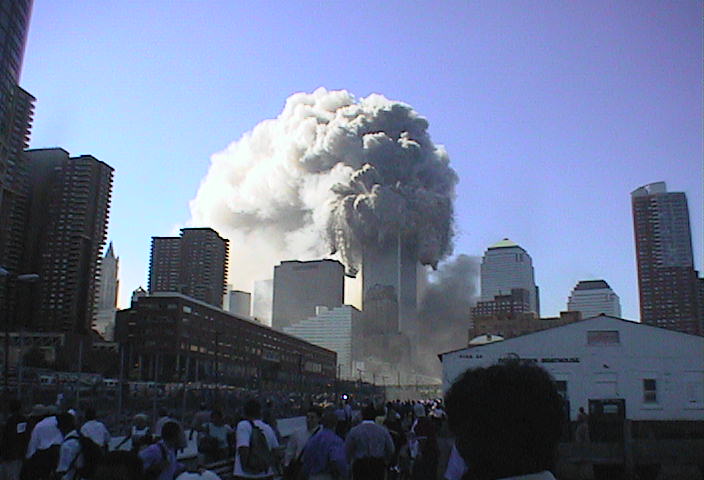
I was minding my own business just like most of the rest of us on September 11th 2001, when my room-mate told me an airplane had crashed into the World Trade Centre. We thought it must have been an accident, much like the B52 that hit the Empire State building in 1945. I picked up my digital camera and roller-bladed down from our apartment on 44th at Times Square to see what was going on, and witnessed the event that changed the world and ended the halcyon 1990s.
My amateur video from the same camera is here, showing the tower falling.


Friday, January 26, 2001
Laser Eye Surgery - the blog
Yesterday I had LASIK laser eye surgery. In short, this is where they take the front part of your eye off, burn a pattern on the surface of the underlying cornea, and put the front bit back on again.
In long...
You have a consultation where your prescription, your pupil size and the shape of your cornea is measured, and they work out if the treatment is possible. Although they can correct myopia and astigmatism, they can't correct everything, such as keratoconus. They also measure the thickness of your cornea to ensure there's enough material to work on. Presumably this is to avoid burning right through your eyeball and making a mess of their shiny new laser by covering it with whatever fluid that might erupt henceforth. Yum.
Having passed over those hurdles, I returned yesterday for the treatment itself. I decided to go to Boots in Regent St., London, on the basis that I'd have easier access to lawyers and a support environment in the UK if something went wrong, than I would in the USA. Also, Nadine works at Boots so it must be good. It was about 50% more expensive than in New York, but then Nadine does get to drive a nice car, and you don't have to tip the surgery when you leave. I was escorted there by the lovely Nurse Melanie. Those of you who know her will not be surprised by the fact that one of the nurses had to explain to Mel, after I'd returned from the Abyss (more below), "you're not meant to be laughing, you know".
Having arrived for the treatment, I sat done with Mel to eat lunch. Shortly thereafter I was rudely interrupted from a rather tasty chicken and mozarella sandwich by the need for yet more tests. They re-checked the measurements and explained that my left eye would be corrected to perfect vision, and my right would be left with about .25 dioptres of myopia. This was to leave a little bit more thickness in the cornea (they wanted to keep their laser clean) and might even delay the need for reading glasses in later life.
The next bit was the though bit. You lie flat on a couch. They produce a clamp that they insert into your eye to hold your eye open. Then a vacuum clamp sucks itself onto your eye. A knife appears and they slice into the top of the eye. Of course, it's your eye, so you get to see this happening. Then the laser comes. Someone explained that I'll probably smell a strange smell. I jokingly said "you mean like the smell of burning flesh?". There was no reply.
And then there was this funny smell of burning flesh.
The main problem was I'd been told the procedure would last 20 minutes. So I thought I would be lasered for 20 minutes. Actually, you're only lasered for 90 seconds. Nevertheless that expectation, plus the thought of what they were actually doing, added up to a very grim time. The guy was saying "stop rolling your eyes!" and I tried to explain, through my hyper-ventilating, that I was unable to control them. Shortly after I realised that backing out wasn't an option. All you want to do is close your eyes and get away, but you can't. Anyway, somehow it all worked out, eventually, and it was over.
But of course, the basic human model comes with two eyes.
So it was on to the next one. This time it wasn't half as bad, as I knew what to expect. Uncomfortable, but ok. I left the room and my eyesight seemed much the same. Over the next few minutes, I tried squinting through my (strong) glasses and realised that they actually made my eyesight worse. So I was now unable to see properly at all, without or without my glasses. What a bargain.
The surgeon came in a few moments later and explained that altough I'd had a "very unusual reaction" (I didn't realise most of the population didn't mind having a vacuum pump clamped to their eyeball) and that I was the most difficult patient he'd had, he was very pleased to say that the machine had done everything it needed to and he thought that I was going to be fine. Mel and I had a nice cup of tea and found plenty to laugh at, non of which I can remember now.
All I had to do then was pay. Funny how they wait until you can't see before asking you to sign the Visa slip...
I was a bit embarrassed for being so squeamish in the theatre, but they were all very nice about it. Two female nurses had been holding me down, it turns out - one with a rubber glove on too. I left before they decided to charge extra for that bit.
I noticed all sorts of things that blind people must live by - the beeps in the underground for when the doors open, the annoucements over the tannoy saying what station you're at, the rough parts of the street where the crossings are. Thankfully Nurse Mel led me back to college.
The next 20 hours or so I spent in the dark. The treatment requires a dilating fluid in the eye which renders the patient photosensitive. I just kept my eyes closed. Other than that I felt fine. My eyes stung a little but nothing too serious. I talked to Mel and called home, but I could only call people who's number I knew off by heart because I couldn't read my address book.
Today, my eyesight has been getting better and better by the minute. I learned to point my eyes in the same direction at about 11am, to read at about 11:30am, to read number plates at a distance about noon, and so on. I cancelled my direct debit for my contact lenses at 12:30. Never imagined I'd be able to do that. Focus is still a bit hazy for reading. I'm writing this because it's easier than reading. I guess it's silly to strain too much today. I get to have a checkup tomorrow.
So, did it work? The objective is to avoid carrying around glasses and contact lenses, and avoid sore dry eyes after transatlantic flights or after sleeping in contact lenses overnight. At this point, I don't know if it worked. My sight isn't as good as it was with glasses, and that wasn't as good as it was with contacts. Hopefully it'll continue to get better. If not, I'll need a new pair of glasses/contacts.
Lessons learned - 1) go with someone. But for Mel and Ma offering, I would have gone on my own without even asking someone to come along, and I'd have had to spend the night outside the clinic on Regent St. 2) it's not the painless, quick operation some of the advertising would let you believe. It's not that it hurts, particularly, so much as the thought of what's going on. Also, it takes a while to recover use of your eyes. Take two days off. 3) Contact lenses are more trouble than you realise, once you don't have to wear them. They're not perfect all the time, they can get a little dirty or dry. Even now, before my eyesight has settled down, it seems to be one of those Change Your Life things, worth every penny.
In long...
You have a consultation where your prescription, your pupil size and the shape of your cornea is measured, and they work out if the treatment is possible. Although they can correct myopia and astigmatism, they can't correct everything, such as keratoconus. They also measure the thickness of your cornea to ensure there's enough material to work on. Presumably this is to avoid burning right through your eyeball and making a mess of their shiny new laser by covering it with whatever fluid that might erupt henceforth. Yum.
Having passed over those hurdles, I returned yesterday for the treatment itself. I decided to go to Boots in Regent St., London, on the basis that I'd have easier access to lawyers and a support environment in the UK if something went wrong, than I would in the USA. Also, Nadine works at Boots so it must be good. It was about 50% more expensive than in New York, but then Nadine does get to drive a nice car, and you don't have to tip the surgery when you leave. I was escorted there by the lovely Nurse Melanie. Those of you who know her will not be surprised by the fact that one of the nurses had to explain to Mel, after I'd returned from the Abyss (more below), "you're not meant to be laughing, you know".
Having arrived for the treatment, I sat done with Mel to eat lunch. Shortly thereafter I was rudely interrupted from a rather tasty chicken and mozarella sandwich by the need for yet more tests. They re-checked the measurements and explained that my left eye would be corrected to perfect vision, and my right would be left with about .25 dioptres of myopia. This was to leave a little bit more thickness in the cornea (they wanted to keep their laser clean) and might even delay the need for reading glasses in later life.
The next bit was the though bit. You lie flat on a couch. They produce a clamp that they insert into your eye to hold your eye open. Then a vacuum clamp sucks itself onto your eye. A knife appears and they slice into the top of the eye. Of course, it's your eye, so you get to see this happening. Then the laser comes. Someone explained that I'll probably smell a strange smell. I jokingly said "you mean like the smell of burning flesh?". There was no reply.
And then there was this funny smell of burning flesh.
The main problem was I'd been told the procedure would last 20 minutes. So I thought I would be lasered for 20 minutes. Actually, you're only lasered for 90 seconds. Nevertheless that expectation, plus the thought of what they were actually doing, added up to a very grim time. The guy was saying "stop rolling your eyes!" and I tried to explain, through my hyper-ventilating, that I was unable to control them. Shortly after I realised that backing out wasn't an option. All you want to do is close your eyes and get away, but you can't. Anyway, somehow it all worked out, eventually, and it was over.
But of course, the basic human model comes with two eyes.
So it was on to the next one. This time it wasn't half as bad, as I knew what to expect. Uncomfortable, but ok. I left the room and my eyesight seemed much the same. Over the next few minutes, I tried squinting through my (strong) glasses and realised that they actually made my eyesight worse. So I was now unable to see properly at all, without or without my glasses. What a bargain.
The surgeon came in a few moments later and explained that altough I'd had a "very unusual reaction" (I didn't realise most of the population didn't mind having a vacuum pump clamped to their eyeball) and that I was the most difficult patient he'd had, he was very pleased to say that the machine had done everything it needed to and he thought that I was going to be fine. Mel and I had a nice cup of tea and found plenty to laugh at, non of which I can remember now.
All I had to do then was pay. Funny how they wait until you can't see before asking you to sign the Visa slip...
I was a bit embarrassed for being so squeamish in the theatre, but they were all very nice about it. Two female nurses had been holding me down, it turns out - one with a rubber glove on too. I left before they decided to charge extra for that bit.
I noticed all sorts of things that blind people must live by - the beeps in the underground for when the doors open, the annoucements over the tannoy saying what station you're at, the rough parts of the street where the crossings are. Thankfully Nurse Mel led me back to college.
The next 20 hours or so I spent in the dark. The treatment requires a dilating fluid in the eye which renders the patient photosensitive. I just kept my eyes closed. Other than that I felt fine. My eyes stung a little but nothing too serious. I talked to Mel and called home, but I could only call people who's number I knew off by heart because I couldn't read my address book.
Today, my eyesight has been getting better and better by the minute. I learned to point my eyes in the same direction at about 11am, to read at about 11:30am, to read number plates at a distance about noon, and so on. I cancelled my direct debit for my contact lenses at 12:30. Never imagined I'd be able to do that. Focus is still a bit hazy for reading. I'm writing this because it's easier than reading. I guess it's silly to strain too much today. I get to have a checkup tomorrow.
So, did it work? The objective is to avoid carrying around glasses and contact lenses, and avoid sore dry eyes after transatlantic flights or after sleeping in contact lenses overnight. At this point, I don't know if it worked. My sight isn't as good as it was with glasses, and that wasn't as good as it was with contacts. Hopefully it'll continue to get better. If not, I'll need a new pair of glasses/contacts.
Lessons learned - 1) go with someone. But for Mel and Ma offering, I would have gone on my own without even asking someone to come along, and I'd have had to spend the night outside the clinic on Regent St. 2) it's not the painless, quick operation some of the advertising would let you believe. It's not that it hurts, particularly, so much as the thought of what's going on. Also, it takes a while to recover use of your eyes. Take two days off. 3) Contact lenses are more trouble than you realise, once you don't have to wear them. They're not perfect all the time, they can get a little dirty or dry. Even now, before my eyesight has settled down, it seems to be one of those Change Your Life things, worth every penny.
Subscribe to:
Posts (Atom)

 Posts
Posts

